
The Modern Lifeline: A Deep Dive into Endovascular Aneurysm Repair (EVAR)
The aorta is the body’s primary circulatory highway. Originating at the heart and extending down through the chest and abdomen, it is responsible for delivering oxygenated blood to every vital organ. However, when the structural integrity of the aortic wall is compromised, it can develop a dangerous bulge known as an Aortic Aneurysm.
Historically, repairing an aneurysm meant a high-risk, "open" abdominal surgery with a long recovery period. Today, Endovascular Aneurysm Repair (EVAR) has revolutionized vascular medicine, offering a minimally invasive alternative that provides a 99% success rate in preventing rupture.

The Modern Lifeline: A Deep Dive into Endovascular Aneurysm Repair (EVAR)
The aorta is the body’s primary circulatory highway. Originating at the heart and extending down through the chest and abdomen, it is responsible for delivering oxygenated blood to every vital organ. However, when the structural integrity of the aortic wall is compromised, it can develop a dangerous bulge known as an Aortic Aneurysm.
Historically, repairing an aneurysm meant a high-risk, "open" abdominal surgery with a long recovery period. Today, Endovascular Aneurysm Repair (EVAR) has revolutionized vascular medicine, offering a minimally invasive alternative that provides a 99% success rate in preventing rupture.
The Silent Threat: Understanding Aortic Aneurysms
An aneurysm occurs when a segment of the aorta weakens and "balloons" outward due to the constant pressure of blood flow. These are often called "silent killers" because most patients remain entirely asymptomatic until a crisis occurs.
Abdominal Aortic Aneurysm (AAA): The most common type, occurring in the section of the aorta that passes through the belly.
Thoracic Aortic Aneurysm (TAA): Occurring in the chest cavity.
While many aneurysms are found incidentally during scans for other issues, some patients may experience warning signs as the bulge grows, such as deep back pain, chest throbbing, dizziness, or shortness of breath.
When is EVAR Recommended?
Surgeons typically recommend EVAR when the risk of the aneurysm bursting outweighs the risks of surgery. Common indications include:
An aneurysm diameter of 5 cm or greater.
Rapid growth or "expansion" of the bulge.
Evidence of aortic dissection (tearing of the vessel layers).
Presence of a focal penetrating ulcer or injury-related trauma.
The patient is not a fit candidate for traditional open surgery due to age or other health factors.
The Procedure: Precision Engineering Inside the Body
The beauty of EVAR lies in its approach. Rather than opening the chest or abdomen, the surgeon works through the "inside" of the vascular system.
Access: Under general or local anesthesia, the surgeon makes a tiny incision in the groin to access the femoral artery.
Navigation: Using Fluoroscopy (live, real-time X-ray), the surgical team threads a thin catheter through the artery until it reaches the site of the aneurysm.
The Stent-Graft: The "hero" of the procedure is the stent-graft—a sophisticated tube made of metal mesh (the stent) covered with a specialized fabric (the graft).
Deployment: A contrast dye is injected to map the area perfectly. The stent-graft is then released from its collapsed state, expanding to fit snugly against the healthy walls above and below the aneurysm.
Exclusion: Once the graft is in place, blood flows through the artificial tube rather than pressing against the weakened aneurysm walls. Deprived of blood pressure, the old aneurysm sac typically shrinks over time.
Recovery and Life After EVAR
Because EVAR avoids large incisions, the body heals much faster than it would after open surgery.
The Hospital Stay: Most patients stay only 2–3 days for monitoring.
Immediate Care: You may be prescribed blood thinners to prevent clots and provided with compression stockings to support circulation.
The First Month: While you can resume light activity quickly, you must refrain from driving, lifting heavy objects, or strenuous gym sessions for 4 to 6 weeks.
Long-term Vigilance: EVAR requires a lifelong commitment to follow-up. Periodic CT scans are necessary to ensure the stent remains in the correct position and that no "endoleaks" (minor leaks around the graft) have developed.
Comparing the Path Forward: Benefits and Risks
EVAR is a remarkably safe procedure, but it is important to weigh the profile against traditional surgery.
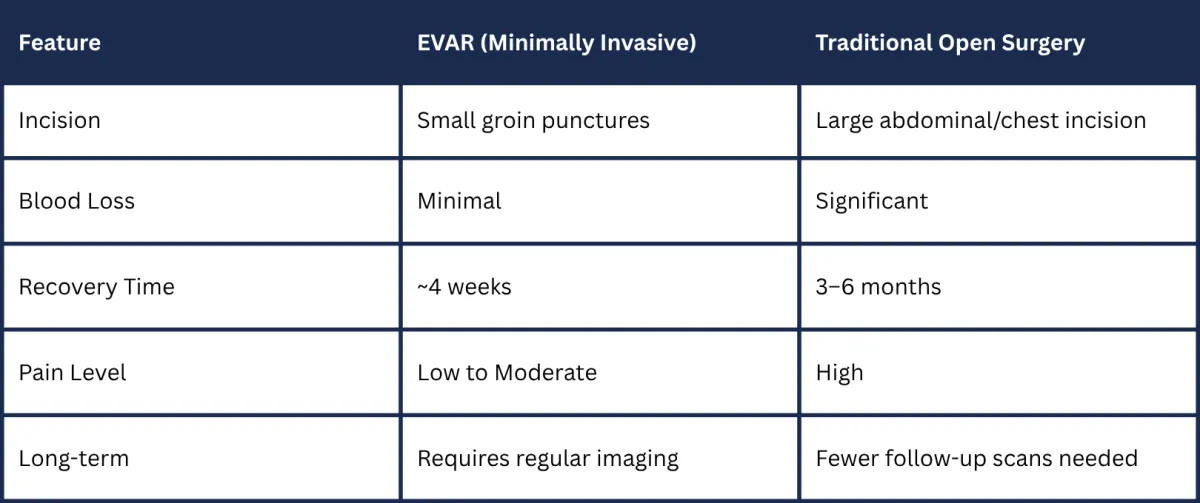
Potential Risks: While rare, complications can include infection, "stent migration" (the device moving), or kidney injury from the contrast dye used during the X-ray.
Summary: A Proactive Approach to Longevity
Endovascular Aneurysm Repair is more than just a surgery; it is a preventative strike against a potentially fatal event. By reinforcing the aorta before a rupture occurs, patients can gain decades of life.
However, the surgery is only one piece of the puzzle. To ensure the longevity of the repair, patients are urged to adopt a "vascular-friendly" lifestyle: quitting smoking, managing blood pressure and cholesterol through diet, and engaging in low-impact exercises like walking or cycling.
If you have been diagnosed with an aneurysm, EVAR represents a pinnacle of modern surgical technology—designed to get you back on your feet quickly and keep you there for years to come.
Are you preparing for a vascular consultation? Bring a list of your current medications and any history of allergies to anesthesia or latex to ensure your surgical team can create the safest possible plan for your EVAR procedure.
Restore your Flow
Don't wait for complications. Schedule your expert assessment today and start your journey to recovery.

Board-certified vascular surgery specializing in advanced life-saving technologies.
NAVIGATE
CONNECT


CLINIC
Monday – Friday : 8:00am – 5:00pm
Saturday-Sunday : Closed
Restoring Flow.
Renewing Life.
Schedule a consultation with Dr. Desai today and experience advanced, compassionate care for your recovery.